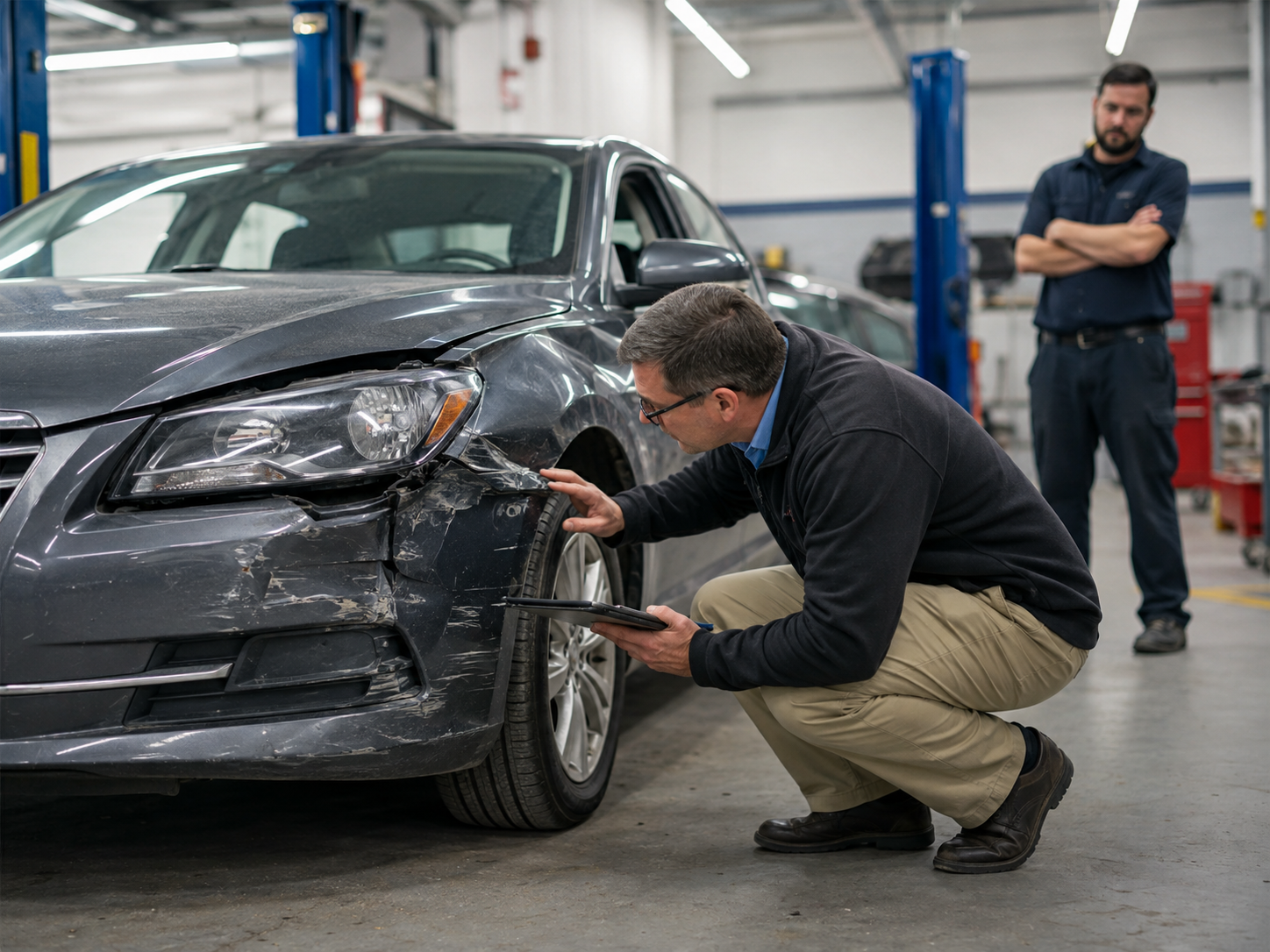
How to Handle a Property Damage Claim After a Long Island Car Accident
Learn when to use your own collision coverage, when to pursue the other driver’s insurer, and what to know about repairs, total losses, rental cars, and diminished value.
After a car accident, most people are understandably focused on whether anyone was hurt. But it usually does not take long for another problem to become important: What am I going to do about my car?
For most of my clients, their car is a necessity. They need it to get to work, take their children to school, go to medical appointments, and handle everyday life. If the car cannot be driven, they need answers quickly.
The property damage portion of a Long Island car accident claim is generally separate from the personal injury claim. You do not have to wait for your injury case to be resolved before dealing with your damaged vehicle.
There are also some important choices to make about how you handle the claim. In many cases, you can pursue the property damage claim through your own insurance company or through the insurance company for the other vehicle.
“In my experience, the choice you make can have a significant impact on how quickly and smoothly the claim gets handled.”
Steven Palermo
What Is a Property Damage Claim?
A property damage claim is a claim for damage to your vehicle and, in some situations, other personal property damaged in the accident.
The biggest part of the claim is usually the vehicle itself. Depending on the extent of the damage, the insurance company may pay to repair the vehicle or determine that the vehicle is a total loss.
But the claim does not necessarily end with the car.
If personal property inside the vehicle was damaged or destroyed in the accident, you may also be able to make a claim for those items. This could include a laptop, cell phone, child car seat, tools, equipment, or other personal belongings.
Steven Palermo
Document what you owned and what it was worth
I always recommend documenting these items as soon as possible. Take photographs and keep receipts, invoices, credit card statements, or other evidence showing what you owned and what it was worth.
You May Have Two Different Ways to Handle the Claim
After a Long Island car accident, there are generally two potential ways to pursue the damage to your vehicle.
You can make a claim through your own automobile insurance company, assuming you purchased collision coverage, or you can pursue the insurance company for the driver who caused the accident.
There are advantages and disadvantages to both approaches.
Your insurance or theirs? Handling your vehicle damage claim
Two ways to get your car repaired after a Long Island accident — and what each one actually costs you in time, money, and hassle.
Collision coverage claimYour Own Insurance
Third-party claimThe Other Driver’s Insurance
Speed
Faster. Liability usually doesn’t need to be established first, so the claim can move right away.
Slower. The carrier typically investigates fault before paying, which can delay repairs.
Deductible
You pay it. Your collision deductible applies up front. You may recover it later through subrogation.
None. No deductible — but you wait on the other carrier’s liability decision to get paid at all.
Who you’re dealing with
Your carrier. You’re the customer. Service tends to be smoother, especially with a reputable insurer.
Not your carrier. You have no policy with them — you’re a claimant against their insured, not a customer.
Policy limits
Protected. Your claim isn’t competing with other victims for a capped payout.
Can be shared. In multi-vehicle accidents, available coverage may be split among several claimants.
Rental car
If purchased. Coverage depends on whether you bought rental reimbursement, with daily and total caps.
After liability. Loss-of-use costs may be recoverable, but only once fault is accepted.
Going Through Your Own Insurance Company
When collision coverage is available, I generally prefer that my clients handle their vehicle damage through their own insurance company.
There are several reasons for this.
1. Your insurance company does not normally need to establish that the other driver was responsible before handling your collision claim
You purchased collision coverage specifically to protect your vehicle when it is damaged in an accident.
That can make a major difference in how quickly the claim moves.
The other driver’s insurance company may want police reports, statements from its insured, photographs, witness information, or other evidence before accepting responsibility. Your own collision carrier generally does not have that same liability issue.
2. You are your insurance company’s customer
In my experience, that can make the process easier, particularly if you are insured by a reputable company with good claims service.
This becomes even more important when the other vehicle is insured by a lower-cost carrier that may be difficult to communicate with or slow to adjust claims.
Not all insurance companies handle property damage claims the same way.
There are some insurance companies that I would much rather have my client deal with than others. There are also certain carriers that I would be reluctant to recommend dealing with even when they insure my own client.
The Biggest Disadvantage: Your Deductible
The obvious disadvantage of using your own collision coverage is the deductible.
If you have a $500 or $1,000 collision deductible, for example, that amount will generally be deducted from the property damage payment.
Your insurance company may later pursue the responsible driver’s insurance company through subrogation. If it successfully recovers its payment, you may ultimately recover some or all of your deductible, depending on the circumstances.
But that does not necessarily help you today.
If paying the deductible creates a financial hardship, pursuing the other driver’s insurance company may make more sense.
When I Might Recommend Going Through the Other Driver’s Insurance
There are situations where I may recommend making the property damage claim directly against the other driver’s insurance company.
The most obvious advantage is that there is no collision deductible.
Another situation is where the other driver has substantially better insurance than my client.
If my client has a carrier that is particularly difficult to deal with and the responsible vehicle is insured by a company known for better claims handling, I may recommend pursuing the third-party claim.
Every situation is different.
But as a general rule, if my client has good collision coverage with a reputable insurance company and can manage the deductible, I usually recommend starting with their own carrier.
Free Consultation
Dealing with a difficult property damage claim?
Whether an insurer is delaying, undervaluing your total loss, or disputing diminished value, Palermo Law can help you understand your options and get your claim moving. Your first consultation is free.
The Problem With a Third-Party Property Damage Claim
When you pursue the other driver’s insurance company, you have to remember something important:
They are not your insurance company.
You did not purchase a policy from them. You are making a claim against their insured.
Before paying your property damage claim, the company will usually investigate whether its insured was legally responsible for the accident.
That can cause delays.
Sometimes liability is obvious. Other times it is disputed. There may also be situations where the other driver has not reported the accident or is not cooperating with the insurance company.
Until the carrier completes its investigation and accepts responsibility, you may be left waiting.
That is one of the major reasons I generally prefer using collision coverage when it is available.
Property Damage Policy Limits Can Matter
Policy limits can also become an issue.
An insurance policy does not provide unlimited money for property damage. The responsible vehicle has a maximum amount of property damage coverage available under the policy.
That can become particularly important in accidents involving multiple vehicles or very expensive vehicles.
Suppose one driver causes an accident involving several cars. The available property damage coverage may have to be divided among multiple claimants.
If the total property damage exceeds the available insurance, there may not be enough money to fully compensate everyone.
Your own collision coverage can protect you from that problem because your claim is being made under your own policy rather than competing with everyone else for the responsible driver’s available property damage limits.
What Happens if Your Car Is Repairable?
If the vehicle can reasonably be repaired, the insurance company will normally obtain an estimate of the cost of repairs.
Depending on the circumstances, you may take the vehicle to a repair shop of your choosing. The insurance company may also have its own inspection process or preferred repair facilities.
Once repairs begin, additional damage is sometimes discovered.
This is common because an initial inspection cannot always reveal everything underneath bumpers, body panels, and other components. The repair facility can typically submit a supplemental estimate to the insurance company for additional accident-related repairs.
What Happens if Your Vehicle Is Totaled?
A car does not have to be completely destroyed to be considered a total loss.
The insurance company looks at the value of the vehicle and the cost of repairing it. If repairing the vehicle no longer makes economic sense under the applicable standards, the carrier may declare it a total loss.
At that point, the fight often shifts from the cost of repairs to the value of the vehicle.
Do not automatically assume the insurance company’s first valuation is correct.
How Can You Challenge a Low Total Loss Offer?
If I believe a total loss valuation is too low, I want to know how the insurance company arrived at its number.
Look carefully at the vehicles being used as comparables.
Are they actually comparable to your vehicle? Do they have the same trim level, mileage, options, condition, and equipment?
I also look for anything that legitimately increased the value of the vehicle.
Did you recently install new tires? Did you add expensive factory equipment or upgrades? Did you make other improvements that increased the vehicle’s market value?
Gather the documentation.
Receipts, photographs, maintenance records, window stickers, option lists, and comparable vehicles being offered for sale can all potentially help establish that the insurance company’s valuation is too low.
You are much more likely to get a valuation increased when you can provide actual evidence rather than simply telling the adjuster that you think the vehicle was worth more.
Explore More
Injured in a Long Island car accident?
Property damage is only one piece of a car accident claim. Learn how Palermo Law handles the full case — from no-fault benefits to serious injury claims — on our Long Island car accident lawyer page.
Transportation is another major concern after an accident.
Whether a rental vehicle is covered depends partly on which insurance company is handling the claim.
If you go through your own policy, rental coverage generally depends on whether you purchased rental reimbursement coverage and the limits of that coverage. There may be a daily maximum, an overall maximum, or both.
If you pursue the responsible driver’s insurance company, you may be able to seek reasonable loss-of-use or rental expenses as part of the property damage claim once responsibility is established.
This is another reason delays in accepting liability can become frustrating. You may need transportation immediately, while the other insurance company is still investigating the accident.
Always ask exactly what rental expenses are authorized before assuming the insurance company will pay the entire bill.
What Is a Diminished Value Claim?
Diminished value claims are becoming a more frequent issue in Long Island car accident cases.
The idea is fairly simple.
Your vehicle may be properly repaired after an accident but still be worth less money than an identical vehicle that was never involved in a significant accident.
Think about buying two identical used cars.
They are the same year, same model, same mileage, and in similar condition. One has never been in an accident. The other was involved in a substantial collision and required significant repairs.
Would you pay exactly the same amount for both?
Probably not.
That difference is the basis of a diminished value claim.
Diminished Value Claims Are Not Always Easy
Insurance companies can be reluctant to voluntarily pay diminished value claims.
It is not enough to simply say that your vehicle must be worth less because it was involved in an accident.
You need proof.
A strong diminished value claim may require an appraisal from a qualified and reputable expert who can explain the vehicle’s value before the accident, its value after proper repairs, and the amount of value that was actually lost because of its accident history.
That creates a practical problem.
An appraisal costs money.
Sometimes the cost of obtaining a professional appraisal and litigating the dispute can approach or even exceed the difference between what the insurance company is offering and what you believe the diminished value claim is actually worth.
That does not mean diminished value claims should not be pursued. It means they need to be evaluated realistically.
The value of the vehicle, severity of the collision, extent of repairs, age and mileage of the vehicle, and amount of the potential diminished value all matter.
My General Approach to Property Damage After a Long Island Car Accident
When a client has collision coverage with a reputable insurance company, my general preference is to start there.
It is usually faster. Liability generally does not have to be resolved first. You are dealing with your own insurance company, and you are less likely to be stuck waiting while another carrier investigates its insured.
There are exceptions.
If the deductible is too difficult for the client to pay, that matters. If the responsible driver has substantially better insurance, that matters too. The quality of the insurance companies involved can also influence my recommendation.
Property damage may seem simple compared with a serious personal injury claim, but there can still be a lot of money at stake.
The key is understanding your options before deciding which insurance company you want handling the claim.
Authored by
Steven Palermo Esq.
Senior Partner, Palermo Law, P.L.L.C.
Steven Palermo is a Long Island personal injury attorney with more than 25 years of experience representing injured victims in Nassau and Suffolk Counties. He is admitted to the New York State Bar and the United States District Court for the Eastern District of New York.
Frequently Asked Questions About Property Damage Claims After a Long Island Car Accident
You may have two options. If you have collision coverage, you can usually make a claim through your own insurance company. You may also pursue the insurance company for the driver who caused the accident. Which option makes more sense depends on liability, your deductible, available coverage, and the insurance companies involved.
In many cases, I recommend using your own collision coverage when you have a reputable insurance company and can afford the deductible. Your carrier generally does not need to establish the other driver's liability first, which can make the property damage claim faster and easier to resolve.
If you use your own collision coverage, your deductible will generally apply even when another driver caused the accident. Your insurance company may later pursue the responsible driver's carrier through subrogation. Depending on the recovery and circumstances, you may eventually receive reimbursement for some or all of your deductible.
Yes. You can generally pursue a property damage claim against the insurance company for the responsible vehicle. The benefit is that you do not have to pay your collision deductible. The disadvantage is that the carrier may investigate liability before paying, which can significantly delay the process.
If your vehicle is declared a total loss, the insurance company will generally determine its pre-accident value rather than pay for repairs. You should carefully review that valuation. Check the mileage, trim, options, condition, comparable vehicles, and any improvements or additions that could legitimately increase your vehicle's value.
Yes. You do not necessarily have to accept the insurance company's first valuation. I recommend gathering objective evidence showing why the vehicle was worth more. Comparable vehicles, photographs, maintenance records, receipts for recent improvements, factory options, trim level, mileage, and overall condition may help support a higher valuation.
It depends on how the claim is handled. Under your own policy, rental reimbursement usually depends on whether you purchased that coverage and its limits. When another driver is responsible, reasonable rental or loss-of-use expenses may be recoverable, but delays can occur while that driver's insurance company investigates liability.
Potentially. A property damage claim can involve more than the vehicle itself. If a laptop, phone, child car seat, equipment, or other personal property was damaged in the collision, document it immediately. Photographs, purchase receipts, credit card records, model numbers, and other evidence can help establish ownership and value.
A diminished value claim seeks compensation when a properly repaired vehicle is worth less because it now has an accident history. These claims can be disputed by insurance companies. Establishing the loss may require a qualified appraisal comparing the vehicle's value before the accident with its market value after repairs.
Many straightforward property damage claims can be handled directly with an insurance company. Problems can arise when liability is disputed, a vehicle is undervalued, coverage is insufficient, or diminished value is involved. In a serious Long Island car accident, I also make sure the property claim does not distract from the personal injury case.
The information provided in this blog is for general informational purposes only and reflects the opinions of the author. It is not legal advice and does not create an attorney-client relationship. Every case is different, and results depend on the specific facts and applicable law. You should not act or rely on any information in this blog without first seeking advice from a qualified attorney regarding your individual situation.